
It’s finally been announced. After years of rumours, leaks and dummy units doing the rounds online, Apple has finally announced their first folding phone.
Apple unveiled it on Wednesday 9 September alongside the iPhone 18 Pro and the Apple Watch Series 12. John Ternus introduced it, eight days into his new job as chief executive after taking over from Tim Cook, describing it as the most transformational change to iPhone since the original. Big words for a first attempt at a form factor Samsung’s been selling since 2019.
Apple was the last of the major manufacturers to get here. Samsung, Google, Oppo, Honor, Motorola and Vivo all arrived first, some of them years ago. Being late isn’t a problem in itself; Apple tend to wait until their devices are completely polished, whereas Samsung tend to launch early and improve over multiple product generations! This only matters if the extra time bought something, and that’s the part worth digging into. We spend our days testing and grading used iPhones, so our interest sits slightly to one side of most launch coverage. What’s one of these like to live with, and what’s it worth in three years?
What Apple announced
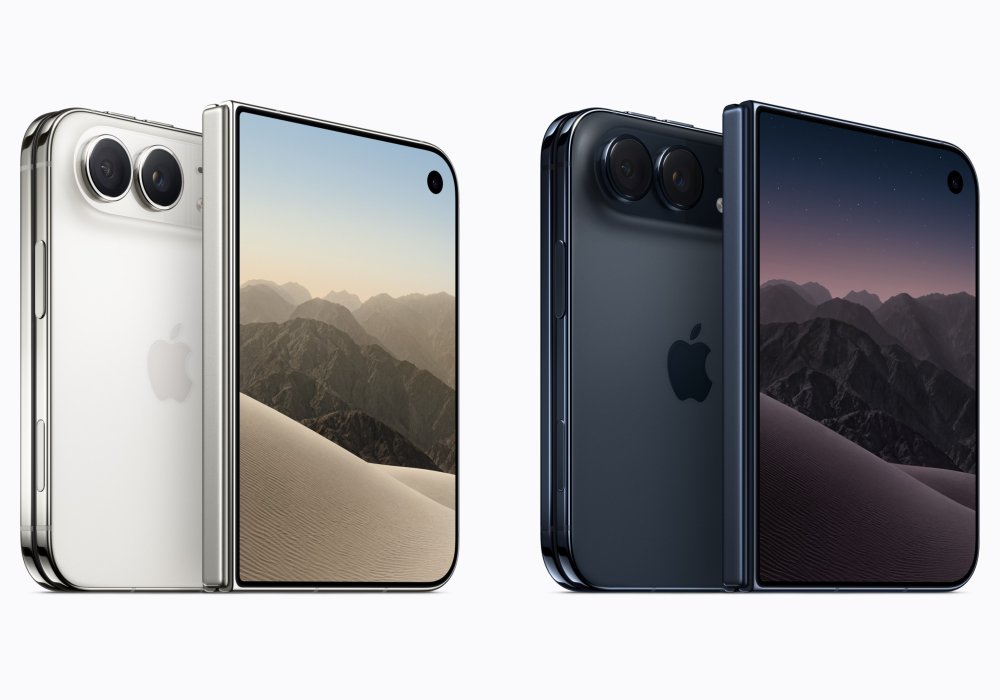
The iPhone Duo is a book-style foldable. Closed, it behaves like a normal, slightly chunky phone with a screen on the front. Opened, it turns into something much closer to a small iPad.
The design decision that matters most got barely a mention on stage. Both displays share the same aspect ratio, so apps don’t reflow every time you open or close the device. Content simply scales. Anyone who’s used an early Android foldable will remember how jarring it is when an app resets its layout halfway through a scroll, and Apple seems to have engineered around that from the start rather than patching it later.
Here’s the hardware in full.
| Inner display | 7.6in Super Retina XDR, ProMotion, Always On, 3000 nits peak brightness, nano-texture finish |
| Outer display | 5.4in Super Retina XDR, roughly 90% of the screen area of an iPhone 18 Pro |
| Thickness and weight | 5.2mm when open, 254g |
| Chip | A20 Pro on a 2nm process, with a custom vapour chamber for cooling |
| Rear cameras | 48MP Fusion Main with an optical-quality 2x telephoto, 48MP Fusion Ultra Wide |
| Front cameras | Centre Stage camera on the outside, an under-display FaceTime camera inside |
| Unlocking | Touch ID built into the side button. No Face ID |
| Build | Grade 5 titanium, Ceramic Shield 2 on the front, Ceramic Shield on the back, IP68 |
| Battery | Two cells, one each side. Up to 31 hours video on the inner screen, 44 hours on the outer, 24 hours mixed use |
| Charging | 50% in around 20 minutes wired, or around 30 minutes on MagSafe or Qi2 |
| Storage | 256GB, 512GB, 1TB, 2TB |
| Connectivity | eSIM only worldwide, C2 modem, N1 wireless chip, Wi-Fi 7, Bluetooth 6, Thread |
| Stylus | Apple Pencil with USB-C, supported later this year. Not the Apple Pencil Pro |
| Software | Ships with iOS 27.1 |
| Colours | Star White, Night Sky |
The crease, and why it Apple took so long
The reason there wasn’t a folding iPhone until now comes down to the line down the middle of the screen. Apple reportedly refused to ship a device with a visible crease and chased the problem regardless of what it cost.
The fix is a stack of engineering rather than one clever trick. Two layers of high-strength glass sit above and below the folding panel, with optically clear adhesives between them that let the layers slide past each other as the screen bends, in Apple’s words like the pages of a book. Doing that relieves the bend stress which normally leaves a permanent trough. On top sits a nano-textured cover layer made from a custom polymer around 40% stiffer than what the industry usually uses. The nano-texture’s doing two jobs at once. Creases show up most when light catches them at an angle, so a matte surface that scatters reflections hides the fold as well as cutting glare. It keeps fingerprints down too, which has been a long-running complaint about folding Android phones.
Early hands-on reports back Apple up, with one useful nuance. Reviewers say you can see the crease faintly if you go looking for it, and that you can’t feel it at all running a finger across the screen. Better than most rivals, then, without being the total absence the marketing implies.
The caveat nobody can clear up yet is time. Every hands-on published this week covers a few hours or days. User testing of the Galaxy Z Fold8 found a visible crease appeared after a week or two of ordinary use, having looked almost flat when it launched. Whether Apple’s adhesive and glass stack ages better is the question that decides what these are like to own, and it won’t be answered until units have been in real hands for a few months.
Durability
This is where our interest sits, because we see what happens to phones long after the launch excitement’s died down.
The chassis is grade 5 titanium with a mirror-polished finish and a 3D-printed hinge cover. The hinge is built from more than a hundred components, engineered to hold the centre of the display flat and control the fold precisely. Support ribs add internal stiffness, antenna splits with ceramic fibre inserts stiffen the frame further, and a titanium plate sits under the display. A lot of that engineering is aimed squarely at how foldables usually die: hinge wear, panels coming away, and frames flexing enough to stress the screen.
The headline durability figure is the IP68 rating, meaning dust-tight and rated for submersion. The Galaxy Z Fold8 carries IP48, which covers water but offers nothing against dust. Anyone who’s taken a foldable to a beach or a building site will know why that gap matters, because grit working its way into a hinge is one of the most common ways these things fail. Apple’s leapfrogged Samsung here, and it might be the most consequential single line on the spec sheet.
Repairability looks promising too. Reporting ahead of launch suggested Apple used a modular internal layout that avoids the ribbon cable routing which makes competing foldables such a nightmare to open, putting the motherboard to one side and running button cables upward rather than across the back of the display. If that turns out to be right, it has real consequences for how long these phones stay economically repairable, and by extension how well they hold their value second hand.
One thing we’ll be watching over the long term is the dual-battery design. There’s a cell on each side, managed by rebalancing algorithms so the two behave as one. Elegant engineering, though it does mean a battery replacement in a few years is a two-cell job rather than a one-cell job. iOS 27 already contains wording referring to batteries in the plural, including a warning about the health of both cells having degraded. How that plays out for replacement costs isn’t something anyone can answer yet.
The cameras
Two rear lenses rather than three. There’s a Fusion Main with a large sensor, fast aperture and sensor-shift stabilisation, plus a Fusion Ultra Wide carried over from the iPhone 18 Pro. Apple gets a 2x zoom by cropping into the main sensor and describes the result as optical quality. No dedicated telephoto lens, because there’s physically nowhere to put one in a chassis this thin.
Where the Duo does something no other iPhone can is in how the two screens work together. You can shoot a selfie on the far better rear cameras while previewing yourself on the outer display, which is the obvious win and the thing every foldable owner ends up using constantly. Duo Preview puts a live feed on the outer screen so whoever you’re photographing can see their own framing. Duo FaceTime lets someone standing next to you join a call on the front display instead of squeezing into shot. Smart Take uses on-device models to fire the shutter when it spots people posing. There’s even a feature called Kid Cue that plays Peanuts animations on the outer screen to get children looking at the lens, which is either charming or mildly dystopian depending on your mood.
Video’s thorough. Dolby Vision recording at high frame rates on the main camera, Cinematic effects you can apply after the fact, and improved Audio Mix processing that can now isolate music. Propping the phone open on a surface removes the need for a tripod on time-lapses, which sounds minor and will get used constantly.
What iOS 27 does with two screens
The software might be the more interesting half of this launch, because it’s the first real change to how iOS works in years.
Lock Screen controls, the Dock and app navigation all shift to the side when the device is open, freeing up vertical space. The Dynamic Island’s been redesigned to run vertically along the edge of either display. Open the phone and you get two Home Screen pages with Today View, a scrolling column of widgets, down the left. Content reacts as the device folds, reorients when you turn it, and moves to whichever screen is facing you when you flip it over.
Split View’s the big one. Two apps side by side on an iPhone, for the first time. You can open two windows of the same app, keep a Siri conversation going on one half while you read the other, and save app pairs to come back to. Netflix, Zoom and Slack already have foldable-aware layouts, and Apple’s published developer tooling to get everyone else moving.
StandBy’s been rebuilt as well. It works on either display and no longer needs the device to be charging, which turns it into a desk clock, photo frame or widget panel whenever you put it down.
iPhone Duo against the Galaxy Z Fold8
The Galaxy Z Fold8 is the only directly comparable wide foldable on sale here, so it’s the fair benchmark.
| iPhone Duo | Galaxy Z Fold8 | |
| Inner display | 7.6in | 7.6in |
| Outer display | 5.4in | 5.5in |
| Thickness open | 5.2mm | 4.5mm |
| Weight | 254g | 201g |
| Water and dust | IP68 | IP48 |
| Rear cameras | 48MP main, 48MP ultra wide, no telephoto | 200MP main, 50MP ultra wide, 10MP 3x telephoto |
| Claimed video playback | Up to 31 hours | Up to 26 hours |
| Stylus | Apple Pencil with USB-C | No S Pen support |
Read that honestly and it’s a split decision. Samsung’s phone is thinner, noticeably lighter, and has a proper telephoto lens with 3x optical zoom that the Duo simply doesn’t have. Apple takes dust protection, claimed battery life and stylus support, and by most accounts the software polish. Apple’s is also the pricier of the two.
For most people the deciding factor won’t appear on either spec sheet. It’ll be whether you fancy leaving iOS, and the answer to that’s nearly always no.
UK price and release date
The iPhone Duo is the most expensive iPhone Apple’s sold, and it isn’t close.
| 256GB | £1,999 |
| 512GB | £2,199 |
| 1TB | £2,599 |
| 2TB | £3,199 |
Pre-orders open at 1pm on Friday 16 October, with devices landing on Friday 23 October across more than 70 countries including the UK. Another 28 markets follow on 30 October. Apple’s UK store lists a 0% APR option over 30 months, which comes to the same total either way, so that choice is about cash flow rather than cost.
Two accessories arrive alongside it, an iPhone Duo Case and a Folio with a built-in kickstand. Apple hasn’t published UK pricing for either yet.
For a sense of scale, an iPhone 18 Pro Max with the same 256GB of storage is £1,299. The folding mechanism costs roughly £700, and that premium holds at every storage tier. Whether it’s worth paying comes down to how much you’d use the bigger screen, which is a hard thing to know before you’ve lived with one for a fortnight.
What it means for the iPhone you already own
This is the part most people should care about, and it’s got very little to do with the Duo.
Every September a new launch pushes the whole range down a rung. The iPhone 17 becomes last year’s model. The 16 and 15 settle into being the sensible-value options. Refurbished prices follow, usually a few weeks behind, because the shift happens when handsets reach customers rather than on announcement day.
Which way that works for you depends on whether you’re buying or selling.
If you’re buying, the weeks after a launch are one of the better windows of the year. A refurbished iPhone 16 is still a thoroughly modern phone with Apple Intelligence, Camera Control and a camera system that handles everyday photography well, and it now sits two generations back rather than one. The refurbished iPhone 15 is a solid performer and a good starting point if you’re stepping up from something a lot older. If you want the Pro camera system without the Pro launch price, look at the refurbished iPhone 16 Pro with its triple-lens setup and 5x optical zoom. You can compare the lot across our refurbished iPhone range.
Everything we sell gets tested across screen, battery, cameras, buttons and connectivity, graded for cosmetic condition, and checked against the national lost and stolen database before it goes anywhere. Twelve-month warranty, thirty-day returns. That’s the difference between refurbished and simply second-hand, and it’s most of what our technicians do all week.
Trading in an iPhone 15, 16 or 17
If you’re selling rather than buying, the timing runs the other way.
Trade-in values for recent iPhones tend to peak in the gap between an announcement and the point where new devices reach customers. Supply of good used handsets is still tight and demand hasn’t been met yet. Once a wave of people upgrade in late October and their old phones hit the market together, prices soften. The difference between selling in September and selling in December is rarely small.
So if you’re planning to move to the Duo, or to an iPhone 18, get a quote now rather than once the dust has settled. An iPhone 17 in good condition still holds a serious amount of value. Even an older handset sitting forgotten in a drawer is worth more today than it’ll be in six months, and it’ll keep sliding for as long as it stays there.
Our iPhone trade-in tool gives you a price in about a minute. Answer a few questions about condition, we send a free Royal Mail recorded delivery label, and payment goes out within one working day of the device arriving and being checked over. If you’d rather put the value straight towards your next phone, take an iOutlet gift voucher instead and it’s worth 5% more than the cash offer. We take iPads, MacBooks, Apple Watches and consoles as well, so if the drawer situation’s got out of hand you can clear the lot in one go.
The environmental case isn’t a throwaway line either. A Royal Society of Chemistry survey put the number of unused devices sitting in British homes at around 40 million, plenty of them in full working order. Every one that gets refurbished and resold is one that doesn’t need building from scratch. Apple’s clearly thought about this with the Duo too, which uses 35% recycled content overall, including fully recycled cobalt in the batteries and fully recycled titanium in the hinge cover.
Is it worth buying?
If you’ve wanted a foldable and refused to leave iOS, this is the one you’ve been waiting for, and it reads as a considered first effort rather than a rushed answer to Samsung. The IP68 rating on its own puts it ahead of the obvious rival on the failure mode most likely to end a foldable’s life.
If you’re upgrading because your current iPhone feels slow or the battery gives up by mid-afternoon, £1,999 is an enormous amount to spend on that problem. A refurbished iPhone a generation or two back with a healthy battery fixes it for a fraction of the outlay, and the money left over isn’t pocket change.
Then there’s a third option, which is probably the one we’d take ourselves. First-generation Apple hardware has a long record of improving sharply in year two. The original iPhone didn’t have an App Store. The first Apple Watch was slow enough to be annoying. A second-generation foldable’s already been reported for 2027, landing on the twentieth anniversary of the iPhone. Waiting a year buys better hardware, a clearer picture of how the hinge and crease age, and the start of a used market for the first generation.
We’ll come back to this post once independent testing lands, particularly on the crease and the hinge over time, since those are the numbers that decide what one of these is worth in three years.
iPhone Duo FAQs
When is the iPhone Duo released in the UK?
Pre-orders open at 1pm on Friday 16 October 2026, with general availability from Friday 23 October 2026. A further 28 countries follow on 30 October.
How much does the iPhone Duo cost in the UK?
It starts at £1,999 for 256GB and goes up to £3,199 for the 2TB model. The 512GB version’s £2,199 and the 1TB version’s £2,599. Apple also offers the cost spread over 30 months at 0% APR.
Does the iPhone Duo have Face ID?
No. Apple’s used Touch ID built into the side button instead, because the folding chassis hasn’t got room for the TrueDepth camera system. You can also unlock it with an Apple Watch.
Does the iPhone Duo have a telephoto camera?
Not a dedicated one. There are two rear lenses, a Fusion Main and a Fusion Ultra Wide, both 48MP. The main camera includes a 2x zoom that Apple describes as optical quality, though there’s no separate telephoto lens like the 5x on the Pro models.
Can you see the crease on the iPhone Duo?
Faintly, at certain angles. Reviewers who’ve handled one report the crease is visible if you look for it and can’t be felt when you run a finger over the screen. How it holds up after months of folding isn’t yet known, since every hands-on report so far covers days rather than months.
Is the iPhone Duo waterproof?
It carries an IP68 rating, meaning dust-tight and tested to a maximum depth of six metres for up to thirty minutes. Better than the Galaxy Z Fold8, which is rated IP48 with no dust protection. Resistance isn’t permanent and drops off with normal wear, and liquid damage isn’t covered under warranty.
Does the iPhone Duo work with Apple Pencil?
Yes, with the USB-C Apple Pencil, and support arrives later this year. It doesn’t work with the Apple Pencil Pro, most likely because there’s no space along the edge for magnetic charging.
Will the iPhone Duo be available refurbished?
Not for a good while. Refurbished stock depends on people trading devices in, so first-generation foldables won’t appear in any real volume until well into 2027. In the meantime our refurbished iPhone range covers everything from current-generation handsets to older models that still do the job nicely.
Should I trade in my old iPhone now or wait?
Now, generally. Trade-in values are usually strongest before a wave of upgraders puts a lot of used handsets on the market at once, which happens in the weeks after a new phone ships rather than when it’s announced.